

The short answers to the SPARE Act questions we hear most: photos are required for each service attempt you rely on, and they travel with the proof of service you file. A phone’s hidden location data probably isn’t enough on its own. The rules apply whether or not your server is registered. And the three-attempt rule calls for genuinely different times of day, not the same time a minute apart.
California’s SPARE Act (AB 747) takes effect January 1, 2027.
These questions came from paralegals, legal staff, and attorneys at One Legal’s fall SPARE Act webinars with Kristian Pujol and Mark Schwartz. New to the law? Start with What Is the SPARE Act? A Guide for California Paralegals.
Is a photo required on every service attempt?
Plan for yes. Under amended CCP § 417.10(a), the proof of service must include photos of the site of each effected or attempted service. The Judicial Council’s proposed forms read the attempt-photo requirement as applying when you’re showing a service method didn’t work. The most common example is the three failed personal service attempts you need before substituted service. Since you can’t go back and take a photo later, the safest practice is to have your server photograph every attempt.
Each photo shows the door of the home or business, or the building or office entrance if the door isn’t reasonably accessible. For public locations, it shows the site of service.
Doesn’t a smartphone already record GPS and the time?
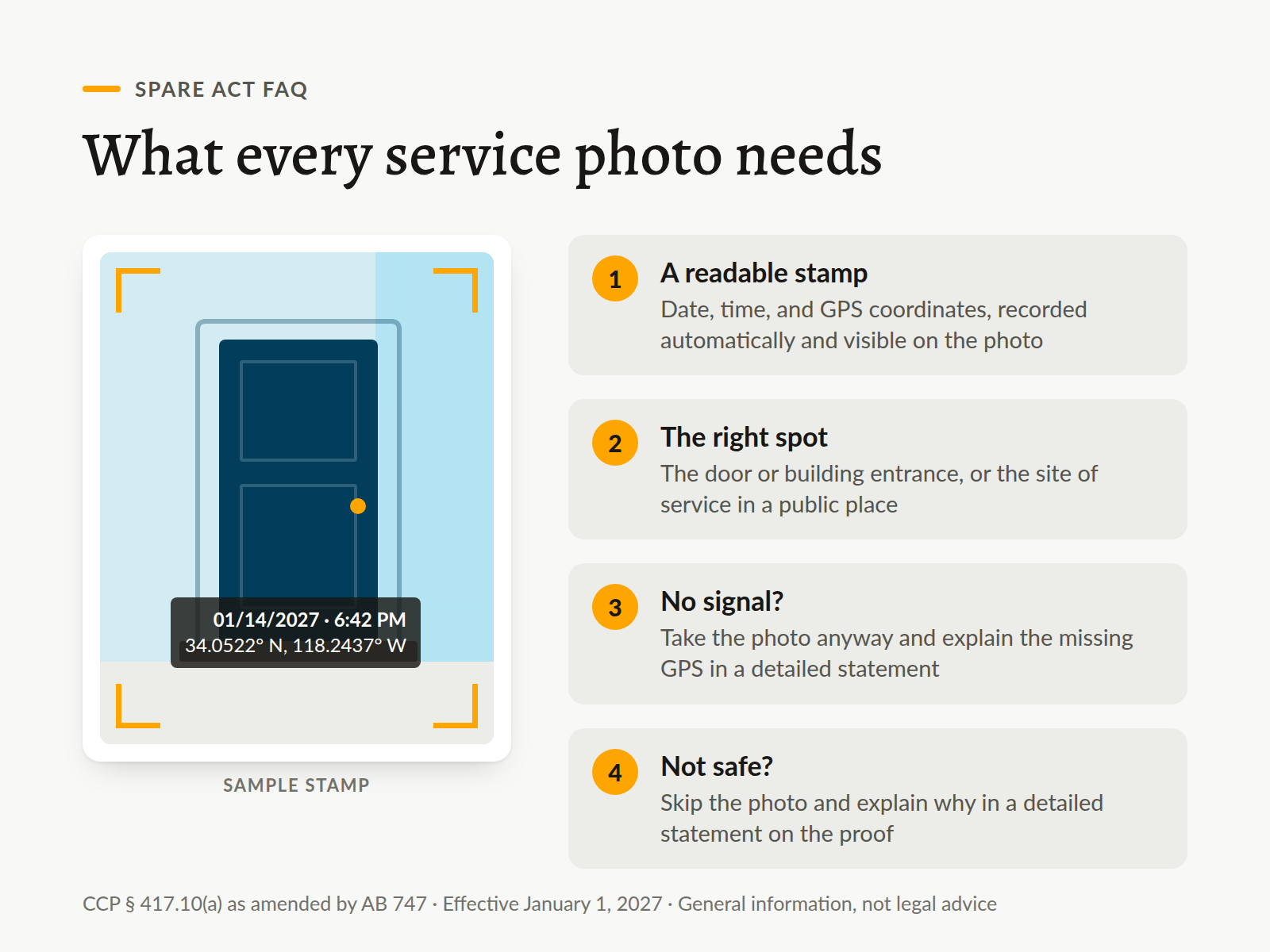 Usually, but not in the way the law asks for. A phone camera typically saves location and time in the photo’s file data, where you can’t see it on a printed or filed image. AB 747 requires a readable stamp that automatically records the date, time, and GPS or equivalent coordinates. In practice, that means a camera app that prints those details onto the image itself. Check that the stamp is still legible once the photo is attached to the proof.
If there’s no GPS or mobile signal, the server still takes the photo and gives a detailed statement on the proof of service explaining why the coordinates are missing.
Already built in with One Legal
One Legal’s process servers can already capture time-stamped, GPS-tagged photos on service attempts, so the documentation AB 747 requires comes with the serve. If you eFile with One Legal but handle service another way, you can add Service of Process to your next order or bundle the whole loop with File-Serve-File: One Legal files your documents, completes service, and files the proof of service. See how One Legal works
Do the photos get filed with the proof of service?
Yes. The statute makes the photos part of the proof of service itself, and the Judicial Council’s proposed Proof of Service of Summons (form POS-010) adds an item for them. That matters for defaults, too. AB 747 clarifies that the clerk can’t enter default without proof of service of the summons, so an incomplete proof can hold up your default request. There are 2 exemptions: when the front door is inaccessible or when there is a safety concern. Both require a statement from the process server explaining the reason for the missing picture.
For a closer look at what the photos and the proof need to include, see AB 747 Documentation Requirements: Photos, GPS Coordinates, and Proofs of Service. Our November 18 and December 2 webinars walk through the new forms themselves.
Do attempts at 9:00, 9:01, and 9:02 a.m. on three days count as “three different times”?
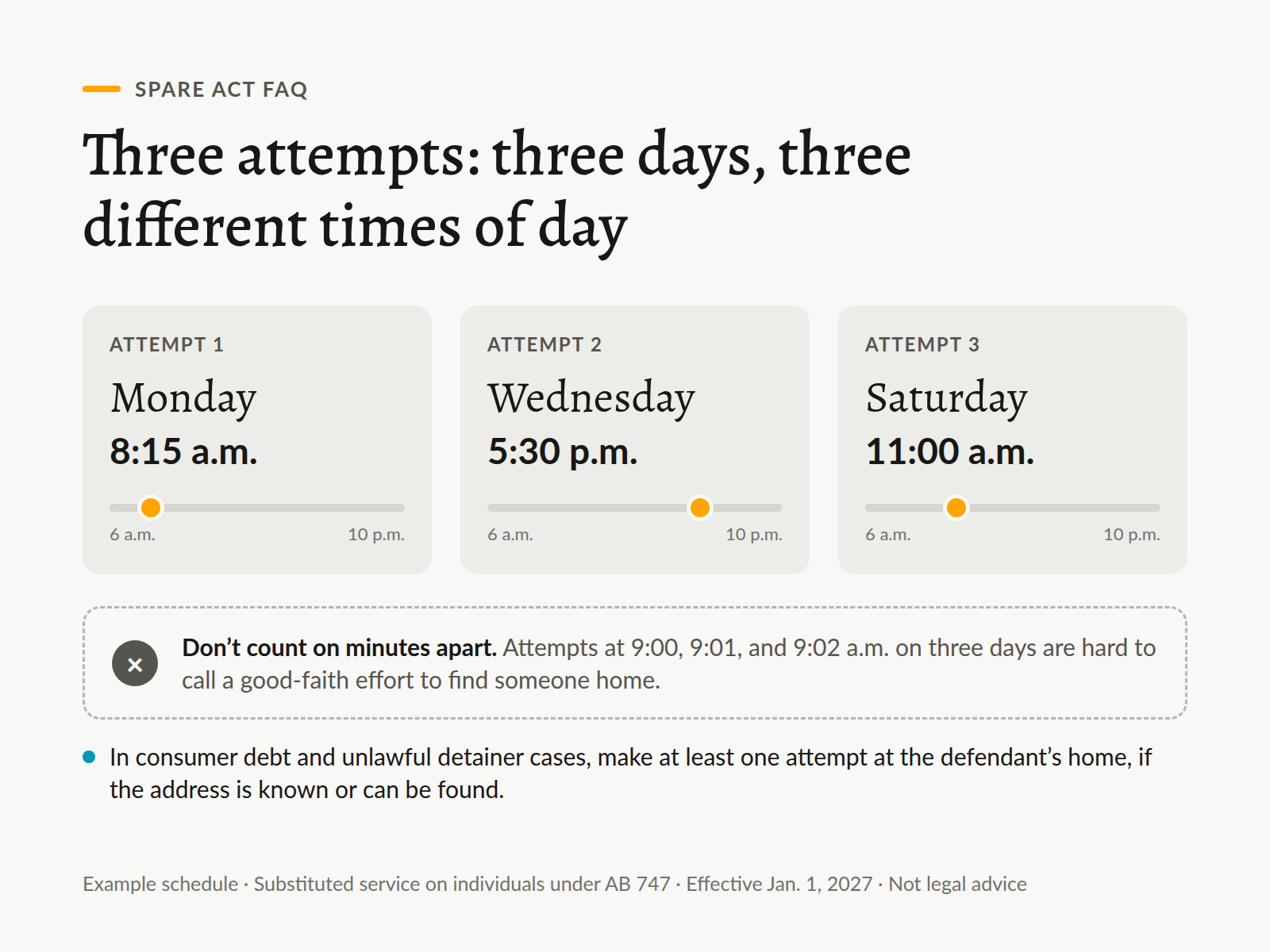 We wouldn’t rely on it. AB 747 defines reasonable diligence for substituted service as attempting personal delivery in good faith on at least three occasions, on three different days, at three different times. The statute doesn’t define “different times,” but minutes apart is hard to square with a good-faith effort to find someone home. Vary the time of day, for example morning, late afternoon, and evening, so the record shows real attempts to reach the person.
Does the SPARE Act apply to servers who are exempt from registration?
Yes. AB 747’s diligence and documentation rules attach to the service itself, not to who performs it. Registered process servers, exempt servers, office staff, and friends or family who serve papers all follow the same photo and attempt requirements. The registration status still matters for the form, since a registered server’s proof includes their registration number.
Does it apply when the sheriff serves?
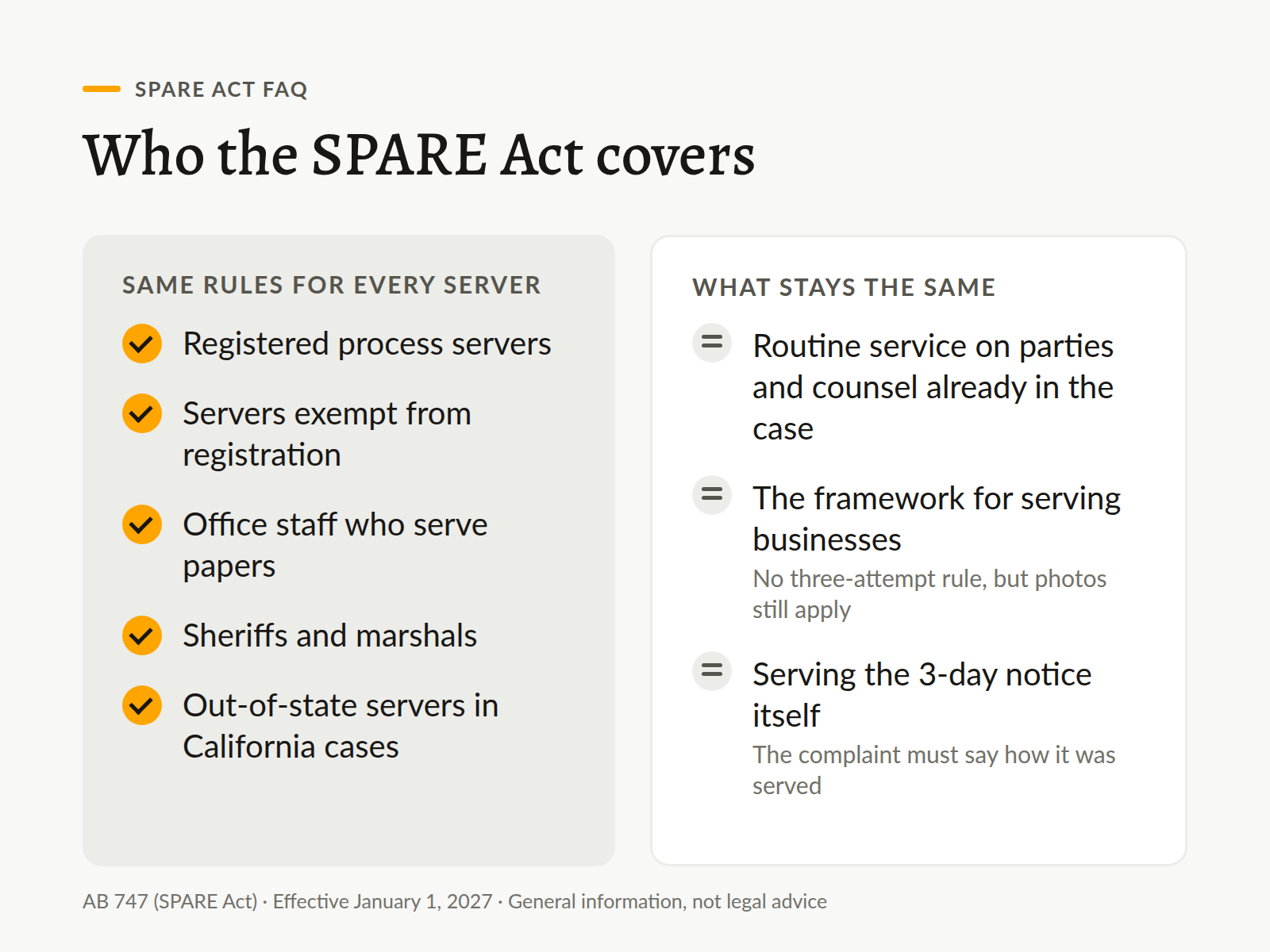 Yes. Sheriffs and marshals serving civil process are covered, and the proposed POS-010 adds a checkbox identifying the server as a California sheriff or marshal. Check with the sheriff’s civil process office about how they’ll provide photos and GPS data with their returns.
Does it apply in family law cases?
For service of the summons and petition, yes. The Judicial Council’s family law proposal (SPR26-21) revises the family law Proof of Service of Summons (form FL-115) to carry the new requirements, which covers dissolution and paternity filings. Domestic violence restraining orders are handled in the same proposal, so check the final forms for exactly which DVRO papers need photos. Separately, the civil proposal would exempt civil harassment and other civil protective order papers from the photo requirement.
What if I’m serving a company listed with the Secretary of State?
The framework for serving businesses stays the same. You can still serve a corporation or LLC through its registered agent at the address on file with the Secretary of State. The three-attempt rule applies to substituted service on individuals, not to business entities. The new photo documentation still applies when service is made by personal delivery or substituted service. That includes documents that have to be served like a summons, such as a notice of entry of a sister-state judgment.
If you’re serving one of the big registered agents, Service of Process in One Legal fills in the agent’s address for you when you pick the agent and state.
Do the new rules change service on parties or counsel in an existing probate case?
Generally, no. AB 747 targets service of the summons, and in probate, citations and similar papers that must be served personally or by substituted service. Routine service of later papers on parties and counsel who have already appeared, such as notices by mail or eService, follows the existing rules. The probate proposal (SPR26-34) updates the forms used when the Probate Code requires that kind of service.
How does the SPARE Act affect 3-day notices in landlord-tenant cases?
The photo and three-attempt rules apply to service of the unlawful detainer summons and complaint, not to the 3-day notice itself. The notice does get a new disclosure, though. Under revised CCP § 1166(a)(5), the unlawful detainer complaint must state the date, time, location, and method used to serve the termination notice. Whoever serves the notice should record those details so they’re ready when you draft the complaint.
Once the case is filed, serving the summons by posting and mailing requires three attempts first, with at least one at the tenant’s home, and the proof needs photos.
Where can I learn more?
- The SPARE Act (AB 747) Compliance Checklist
- AB 747 Documentation Requirements: Photos, GPS Coordinates, and Proofs of Service
- AB 747 and Reasonable Diligence: Service Attempts and Substituted Service
- Who Must Comply with AB 747?
Sources: AB 747 bill text · Judicial Council invitations to comment SPR26-08, SPR26-21, and SPR26-34.
Have a question we didn’t cover? Bring it to our next SPARE Act webinar on the new proof of service forms. It runs 45 minutes on November 18 or December 2 and earns 0.5 CLE credit. Register for Nov 18 → | Register for Dec 2 →
Ready to hand off service? Add Service of Process to your next eFiling order.
This article is for general informational purposes and isn’t legal advice. Confirm current bill status, effective dates, and Judicial Council form releases before relying on it for compliance decisions.