

Last updated September 2026
The SPARE Act is California’s Assembly Bill 747. It takes effect January 1, 2027. It changes how you perform and document service of process in California civil cases. Proof of service will need photos, timestamps, and GPS coordinates. Substituted service will require a defined “reasonable diligence” standard: three attempts, on three different days, at three different times. The law applies to anyone serving civil process in California, not just registered process servers. That means most firms have real, immediate operational work to do before the new year.
Here’s what it means for your firm, broken down by the questions legal staff are actually asking.
What is the SPARE Act?
SPARE stands for Service of Process Accountability, Reform and Equity. It’s the popular name for Assembly Bill 747, authored by Assemblymember Ash Kalra and sponsored by the California Low Income Consumer Coalition. Governor Newsom signed AB 747 into law on October 10, 2025. The Secretary of State chaptered it that same day as Chapter 563, Statutes of 2025.
The law targets “sewer service” — the practice of falsely claiming a defendant was served when they never were. Consumer advocates and the courts have flagged this as a long-running due process problem. It shows up most often in debt collection and unlawful detainer cases. A defendant who never received notice can still end up with a default judgment against them.
When does the SPARE Act take effect?
The SPARE Act takes effect January 1, 2027. The Judicial Council is still finalizing forms and implementation guidance. But the underlying requirements are set. Firms have roughly four months to get workflows in order.
What does the SPARE Act actually change?
Three things, in order of impact:
1. A defined “reasonable diligence” standard. For substituted service on individuals, the law now requires three service attempts, on three different days, at three different times. Only after that can you use substituted service. Previously, case law defined “reasonable diligence” loosely, and interpretations varied. This standard applies to substituted service on individuals under CCP 415.20(b). It does not apply to service on corporations or other business entities under CCP 415.20(a), which follows a different framework.
2. New photo, timestamp, and GPS documentation. Every proof of service — for both successful and attempted service — will need a photograph of the service location with a readable stamp showing date, time, and GPS (or equivalent) coordinates. The photo documents the location, not the person you served: a door or entrance for a residence or business, or the site itself for a public place like a sidewalk or parking lot.
3. A public statewide process server registry. Starting January 1, 2027, counties must make their process server registries publicly available statewide. This standardizes a system that previously varied by county.
Who does the SPARE Act apply to?
The SPARE Act applies to almost anyone serving civil process in California, not just registered process servers. The diligence and documentation requirements attach to the service itself and the proof of service, no matter who performs it. That includes:
- Registered process servers
- Unregistered individuals (friends, family, employees) who occasionally serve papers
- Sheriffs and marshals
- Licensed private investigators
- Out-of-state process servers serving California defendants
The law does not change California’s existing registration thresholds. Business & Professions Code § 22350 still governs those — generally 10+ paid services a year for individuals. It also doesn’t create special rules for notaries or private investigators beyond what already existed.
Does the SPARE Act apply to unlawful detainer cases?
Yes, with some UD-specific additions layered on top of the general civil rules:
- New diligence requirements for posting in unlawful detainer actions
- A requirement that UD complaints state the date, time, location, and method used to serve the termination notice (under revised CCP 1166(a)(5))
The new diligence requirements govern service of the summons and complaint. The termination notice itself gets its own, separate disclosure requirement.
Does the SPARE Act add rules for consumer debt cases?
Yes. Under CCP 415.20(b)(3), you must make at least one substituted service attempt in qualifying consumer debt matters at the defendant’s dwelling or usual place of abode — if you know that address or can determine it with reasonable effort. This requirement applies specifically to consumer debt actions, not to civil cases broadly.
What does the SPARE Act not change?
It’s easy to over-read a law this significant, so let’s be precise about the boundaries:
- Criminal cases — the law is limited to civil service of process.
- Subpoenas — not covered.
- Alternative service methods — service on opposing counsel, court-ordered alternative service, and service by publication are untouched.
- Drop service — still legal where California courts recognize it; it now carries the same documentation requirements as any other service.
- Business entity service — the core framework for serving corporations, LLCs, and partnerships stays the same, though the new documentation rules still apply when service happens under a covered method.
- Virtual businesses — entities must still keep a registered agent with a California street address on file with the Secretary of State; service to that address is unaffected.
- Filings after the initial summons and complaint — once a defendant has appeared and litigation is underway, existing rules for subsequent filings stay the same.
What should my firm be doing now to prepare for the SPARE Act?
The effective date is a few months out, but the operational lift is real. Priorities, in order:
- Audit your service-of-process vendors now. Ask directly: can they capture photo, timestamp, and GPS data in a way that satisfies the “readable stamp” requirement? If the answer is unclear, have that conversation this month, not in December.
- Review documentation and storage workflows. You’ll need to retain photos and location data, then attach them to the proof of service filing itself. Figure out where that lives before January.
- Watch for revised Judicial Council forms. Civil (POS-010), unlawful detainer, family law (e.g., FL-115), and probate forms will likely change in the final months before the effective date. Build in time to adjust your filing workflows once they land.
- Train staff who aren’t registered process servers. Anyone in the office who occasionally hand-delivers papers is still on the hook for the new documentation standard. Make time for training any internal staff who serve directly.
- Talk to your out-of-state servers now to confirm they understand California’s new requirements, rather than discovering a gap after the law takes effect.
How One Legal is preparing for the SPARE Act
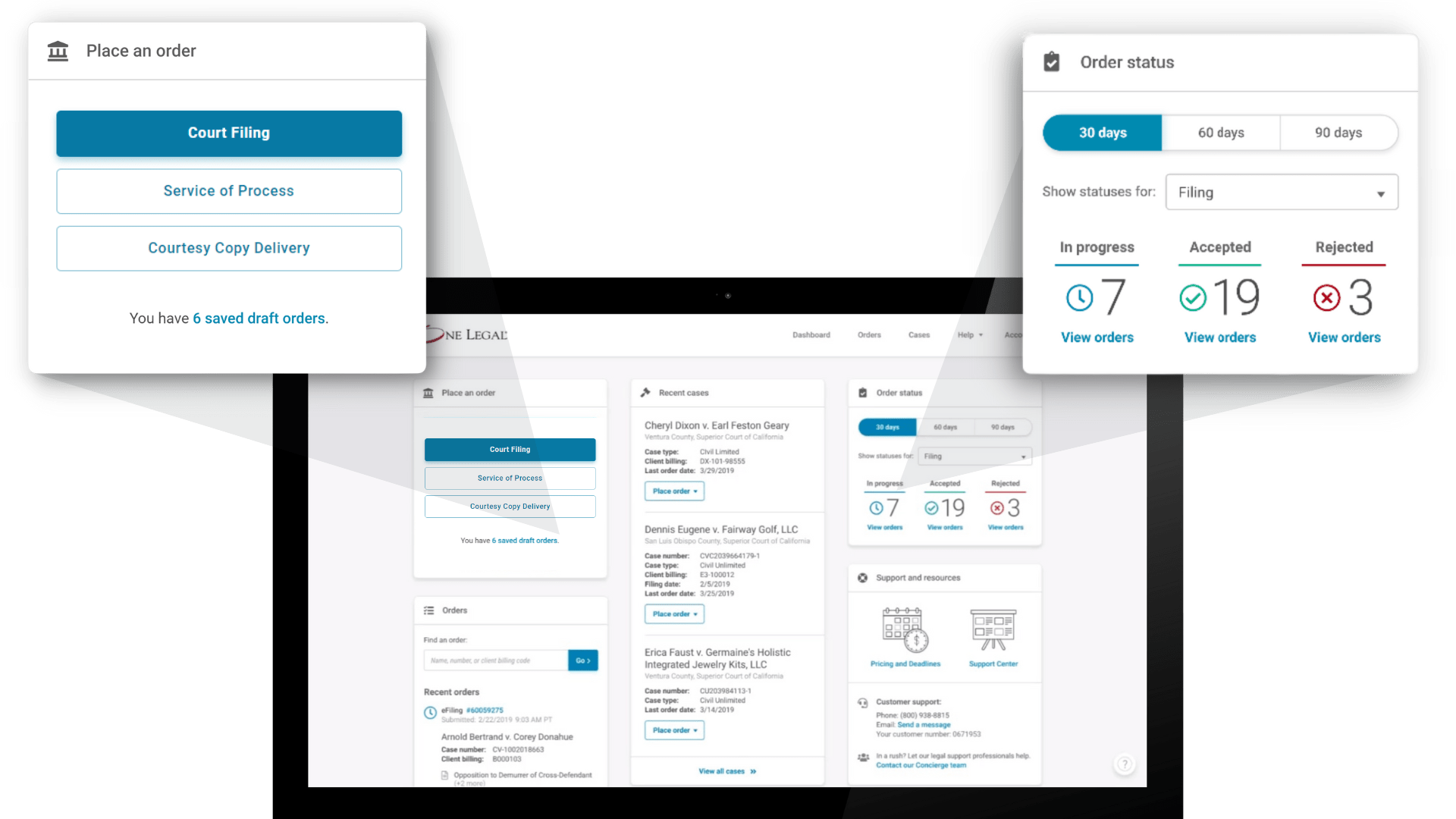
One Legal’s process serving network and mobile app already handle this kind of chain-of-custody documentation, and our team is tracking the Judicial Council form revisions as they’re finalized. See how One Legal handles service of process today, or request a demo to talk through what SPARE Act readiness looks like for your firm.
Go deeper on a specific requirement
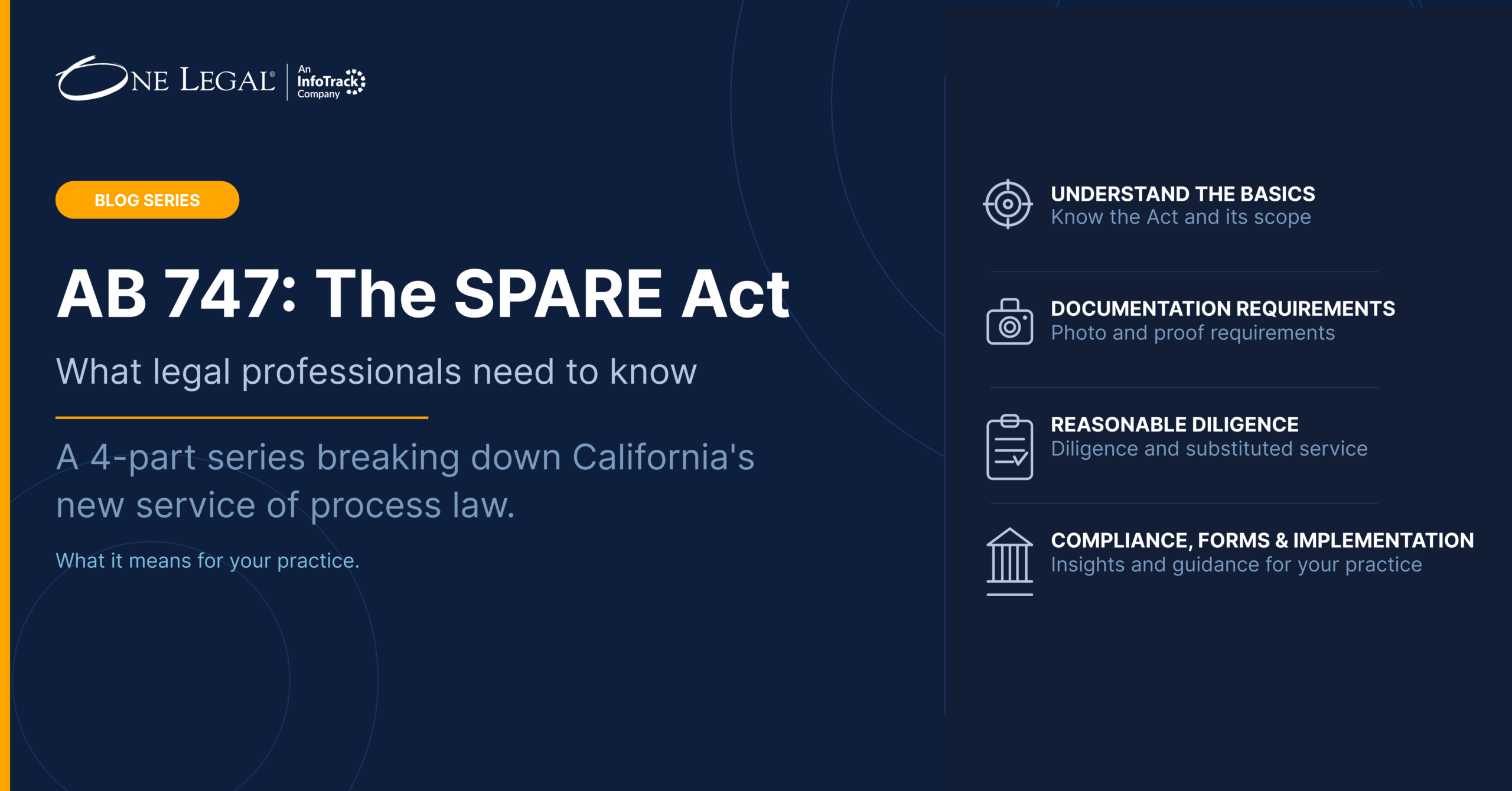
This guide covers the fundamentals. For a closer look at any one piece, One Legal’s team has published a four-part series digging into the details:
- AB 747 Basics: Scope, Applicability, and What the SPARE Act Changes — a deeper FAQ on what case types and service methods are covered, and what’s explicitly carved out.
- AB 747 Documentation Requirements: Photos, GPS Coordinates, and Proofs of Service — what exactly gets photographed, what happens with no GPS signal, and the safety exception for skipping a photo.
- AB 747 and Reasonable Diligence: Service Attempts and Substituted Service — the three-attempt standard explained in full, plus how it applies (and doesn’t) to drop service, sheriffs, and commercial property.
- Who Must Comply with AB 747? Registration Requirements, New Forms, and Implementation — the public registry, Judicial Council form changes, and how the law applies to unregistered servers and out-of-state process servers.
Sources: AB 747 bill text, California Legislative Information; One Legal’s four-part AB 747 explainer series.
This article is for general informational purposes and isn’t legal advice. Confirm current bill status, effective dates, and Judicial Council form releases before relying on this guide for compliance decisions.