
Since the passage of California’s SPARE Act (AB 747), One Legal has received hundreds of questions from legal professionals seeking to understand how the law will impact service of process beginning January 1, 2027.
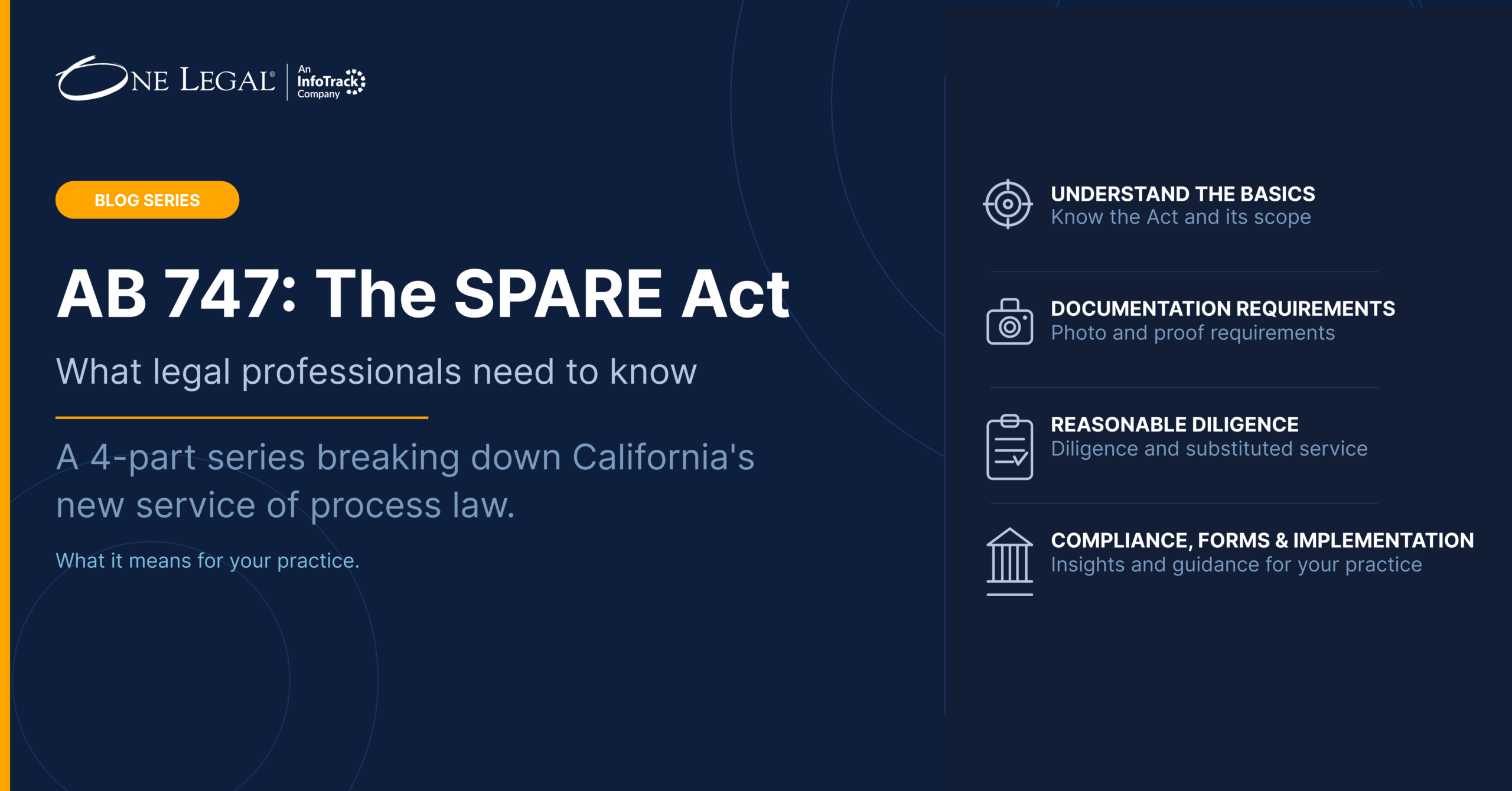
To help answer those questions, we compiled some of the most common inquiries from our webinars, customer conversations, and industry discussions. This blog article is part of a four-part series that provides practical guidance on the SPARE Act’s requirements and what legal professionals should be doing now to prepare.
In this final installment, we focus on who must comply with AB 747, what the law means for registered and unregistered process servers, and what legal professionals should know about implementation, forms, and registration requirements.
Does AB 747 apply only to registered process servers?
No.
The diligence and documentation requirements established by AB 747 apply regardless of whether the individual performing service is a registered process server.
The law’s requirements attach to the service itself and the proof of service, not solely to the status of the person performing the service.
As a result, many of the law’s new requirements apply broadly whenever service of process is completed under the covered statutes.
Does AB 747 apply to unregistered servers, such as friends or family members?
Yes.
The law’s diligence and documentation requirements apply regardless of whether the person serving documents is a registered process server.
If service is performed under a method covered by AB 747, the associated documentation and proof-of-service requirements generally apply.
Does AB 747 require all process servers to register?
No.
AB 747 does not change California’s existing process server registration thresholds.
Under Business and Professions Code section 22350, individuals generally must register as process servers if they serve process for compensation more than ten times during a calendar year. Corporations and partnerships deriving compensation from service of process are generally required to register regardless of volume.
AB 747 does not modify these registration requirements.
How does AB 747 affect private investigators?
The law does not change existing registration exemptions for licensed private investigators.
Under current law, licensed private investigators and their employees remain exempt from process server registration requirements. However, the diligence and documentation requirements established by AB 747 still apply when service is performed under the covered statutes.
How does AB 747 affect notaries?
AB 747 does not create special registration requirements for notaries public.
Whether a notary must register as a process server depends on the same registration standards that apply to anyone else performing service of process. Holding a notary commission does not independently trigger or eliminate registration requirements.
What is changing with the public process server registry?
Beginning January 1, 2027, county process server registries must be publicly available.
Prior to AB 747, access to these registries varied by county. The SPARE Act standardizes public access statewide.
Depending on the county, publicly available registry information may include:
- Registration numbers
- Business addresses
- Bond information
- Employer information
- Other identifying registration records
The Legislature’s stated goal is to increase accountability and transparency within the process serving industry.
Are there privacy concerns regarding the public registry?
Privacy concerns have been raised regarding the public availability of process server information.
The registry may contain identifying information associated with a process server’s registration, including address and business information.
For individuals who qualify, California’s Safe at Home program may provide address confidentiality protections. Eligibility requirements and program details are established separately under California law and are not created by AB 747.
Will out-of-state process servers need to comply with AB 747?
Yes.
When serving California process, out-of-state process servers will need to comply with California’s service requirements.
As AB 747 takes effect, legal professionals coordinating service outside California may wish to confirm that their service providers understand and can comply with the new documentation and proof-of-service standards.
Will AB 747 affect service of process pricing?
AB 747 introduces additional documentation requirements and operational considerations for service providers.
However, pricing decisions remain specific to each provider and their individual service model.
Legal professionals may wish to discuss compliance readiness and documentation capabilities with their service providers as implementation approaches.
Are new Judicial Council forms being created?
Yes.
Several new and revised Judicial Council forms are being developed to support implementation of AB 747.
These updates include revisions affecting civil matters, unlawful detainer proceedings, family law matters, probate proceedings, and other case types.
Among the forms currently under review are revisions to proof-of-service forms and new declarations designed to capture the additional diligence and documentation required by the SPARE Act.
Are Judicial Council forms mandatory?
Yes.
AB 747 does not change the longstanding requirement that proofs of service be completed using Judicial Council-approved forms where required.
What the law changes is the information that must be included in those forms and the supporting documentation that accompanies them.
As revised forms are finalized, legal professionals should expect proofs of service to include significantly more detail than many current versions.
Are there county-specific AB 747 forms?
No.
AB 747 does not create county-specific forms.
The forms being developed in response to the SPARE Act are statewide Judicial Council forms intended for use throughout California.
Individual courts may continue to require local forms or local filing documents unrelated to AB 747, but the service-of-process requirements established by the statute apply statewide.
Does AB 747 apply to family law matters?
Yes, but family law proceedings use their own proof-of-service forms.
For example, family law cases commonly rely on forms such as FL-115 for service of summons and petition documents.
AB 747’s photo, date, time, and GPS requirements are expected to be incorporated through revisions to the family law forms rather than through the civil POS-010 proof-of-service form.
What should legal professionals be doing now?
Although AB 747 does not take effect until January 1, 2027, implementation planning should already be underway.
Legal professionals may wish to consider:
- Whether existing service providers are prepared for compliance
- How documentation will be reviewed and retained
- Whether internal procedures should be updated
- How revised Judicial Council forms may affect filing workflows
- What training may be necessary for staff and vendors
The law’s operational impact will extend beyond process servers and may affect litigation support, docketing, filing, and case management workflows as well.
Final thoughts
AB 747 introduces new diligence, documentation, and transparency requirements that will affect many aspects of service of process in California.
While some implementation details continue to develop through revised Judicial Council forms and related guidance, the law’s direction is clear: service of process will become increasingly documentation-driven and standardized beginning in 2027.
Understanding who must comply, what documentation will be required, and how implementation may affect existing workflows can help legal professionals prepare well before the law takes effect.
If you would like to learn more about the SPARE Act, watch One Legal’s on-demand webinar and explore Part 1, Part 2, and Part 3 of our AB 747 blog series.