
Since the passage of California’s SPARE Act (AB 747), One Legal has received hundreds of questions from legal professionals seeking to understand how the law will impact service of process beginning January 1, 2027.
To help answer those questions, we compiled some of the most common inquiries from our webinars, customer conversations, and industry discussions. This blog is part of a four-part series designed to provide practical guidance on the SPARE Act’s requirements and what legal professionals should be doing now to prepare.
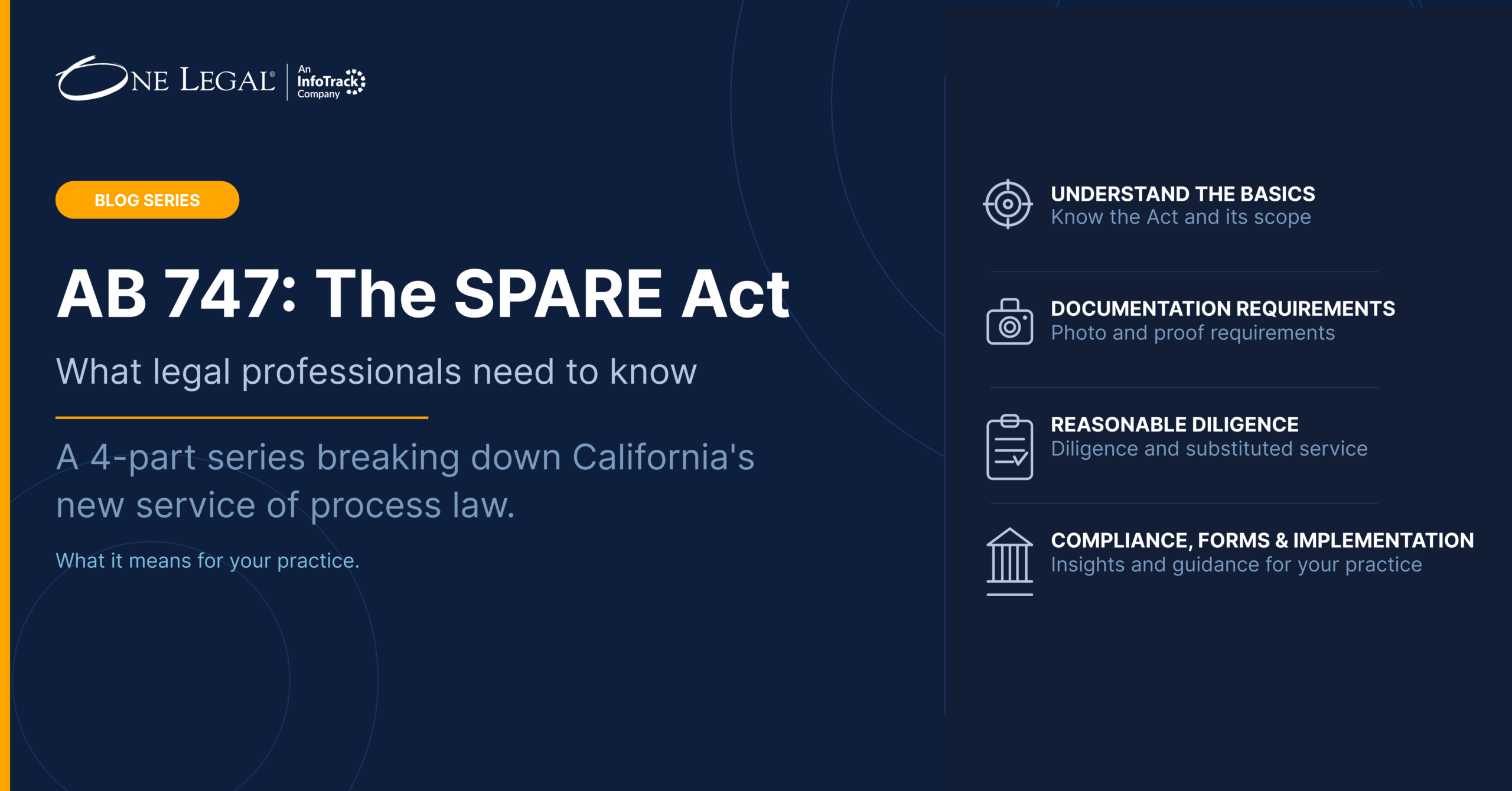
In this installment, we focus on another significant aspect of the SPARE Act: reasonable diligence, substituted service, and the new standards surrounding service attempts.
How does AB 747 change substituted service?
AB 747 makes significant changes to substituted service by creating a defined reasonable diligence standard and requiring additional documentation of service attempts.
Under the new law, service attempts must be documented and reflected in the proof of service. In addition, certain matters may require service attempts at specific locations before substituted service can be used.
These changes are intended to create more consistent standards for determining when substituted service is appropriate.
What is the new reasonable diligence standard?
One of the most notable changes in AB 747 is that the law now defines reasonable diligence for purposes of substituted service.
Generally, reasonable diligence will require:
- Three service attempts
- On three different days
- At three different times
This standard applies before substituted service may be used in situations where reasonable diligence is required.
In addition to meeting these requirements, each attempt must be documented in accordance with the law’s new evidence and proof of service requirements.
Does every type of substituted service require the three-attempt standard?
No.
The three-attempt reasonable diligence requirement is primarily associated with substituted service on individuals under CCP 415.20(b).
Service on corporations and other business entities under CCP 415.20(a) follows a different framework and does not require the same three-attempt showing before substituted service can be completed.
Legal professionals should carefully distinguish between service on individuals and service on entities when evaluating compliance requirements.
Are there additional requirements for consumer debt cases?
Yes.
AB 747 imposes an additional requirement in certain consumer debt actions.
Under CCP 415.20(b)(3), at least one substituted service attempt must be made at the defendant’s dwelling or usual place of abode “…provided that the dwelling place or usual place of abode is known or could be determined with reasonable effort” before substituted service may be completed.
This requirement applies specifically to qualifying consumer debt matters and does not apply broadly to all civil actions.
How does AB 747 affect service on business entities?
AB 747 does not fundamentally change the existing framework for serving corporations, partnerships, LLCs, or other business entities.
Service on business entities generally continues to be directed to the appropriate registered agent or authorized representative.
However, the new documentation requirements—including photographs, date and time information, and GPS coordinates—still apply when service is performed under the methods covered by the statute.
Are there different rules for commercial properties?
For the most part, AB 747 treats commercial and residential service similarly.
The law’s documentation requirements apply regardless of whether service occurs at a residence or business.
One notable exception involves unlawful detainer matters. Commercial unlawful detainer actions are exempt from certain dwelling-attempt requirements that may apply in residential unlawful detainer cases.
How does AB 747 affect unlawful detainer posting?
AB 747 introduces new diligence requirements that affect posting in unlawful detainer actions.
As with other areas of the law, the goal is to create a more consistent and documented record of service efforts before alternative methods of service are used.
The law also requires unlawful detainer complaints to include additional information regarding the service of termination notices, including the date, time, location, and method of service.
What happens when a business operates virtually?
AB 747 does not change the rules for serving virtual businesses.
California entities must continue to maintain an agent for service of process with a California street address on file with the Secretary of State.
Service attempts may still be made at the address of record, even when the business operates through a virtual office, coworking space, or similar arrangement.
The primary impact of AB 747 is that service attempts at those locations will now require additional documentation.
Does AB 747 change drop service?
No.
California courts have long recognized drop service as a form of service when a subject refuses to physically accept documents after being properly identified.
AB 747 does not change the legal validity of drop service.
However, because drop service is considered service, the new documentation requirements apply. This includes photographs, date and time information, GPS coordinates, and the information required by the revised proof-of-service forms.
Process servers should also continue to document the circumstances that justified the use of drop service.
What if service occurs somewhere other than a home or workplace?
Service is not limited to residences and business locations.
If personal service is successfully completed at another location, service may still be valid.
However, the documentation requirements established by AB 747 continue to apply. The location of service must still be documented through the required photographs and related information, even if service occurs somewhere other than a home or workplace.
Does AB 747 affect sheriff service?
Yes.
AB 747 applies to sheriffs and marshals in the same manner it applies to other service providers with respect to diligence and documentation requirements.
Photographs, date and time information, GPS coordinates, and other proof of service requirements generally apply when sheriffs serve summonses and complaints through personal service, substituted service, or unlawful detainer posting.
Existing exemptions regarding process server registration remain unchanged. Sheriffs and marshals are not required to register as process servers, and existing proof-of-service certification procedures remain available to them.
Why do these changes matter?
AB 747 places greater emphasis on creating a clear and defensible record of service.
Whether service is completed through personal service, substituted service, unlawful detainer posting, or drop service, courts and litigants will have access to more information regarding the efforts made to locate and serve a defendant.
As a result, legal professionals may want to review existing service workflows, vendor relationships, and proof-of-service review procedures before the law takes effect.
Final thoughts
AB 747’s new reasonable diligence standards represent a significant shift in how service attempts and substituted service will be documented in California civil litigation.
While many of the underlying service methods remain unchanged, the level of documentation required to support those methods is increasing. Understanding these requirements now can help legal professionals prepare their processes well before January 1, 2027.
In the final article of this series, we will examine who must comply with AB 747, how the law affects registered and unregistered process servers, and what legal professionals should know about new Judicial Council forms and implementation requirements.
If you would like to learn more about the SPARE Act, watch One Legal’s on-demand webinar or explore Part 1, Part 2, and Part 4 of our AB 747 blog series.